
The Leonidas high-power microwave system (IFPC-HPM), created especially to neutralize drones, was recently unveiled by the American company Epirus.
The system effectively disabled 49 quadcopters at once, the greatest swarm Leonidas has ever met, according to Axios, whose journalists were the only media representatives present at the tests. All of the drones fell nearly immediately after being activated.
The U.S. Army is already using the system. On July 17, 2025, a contract worth $43.55 million was signed for its purchase.
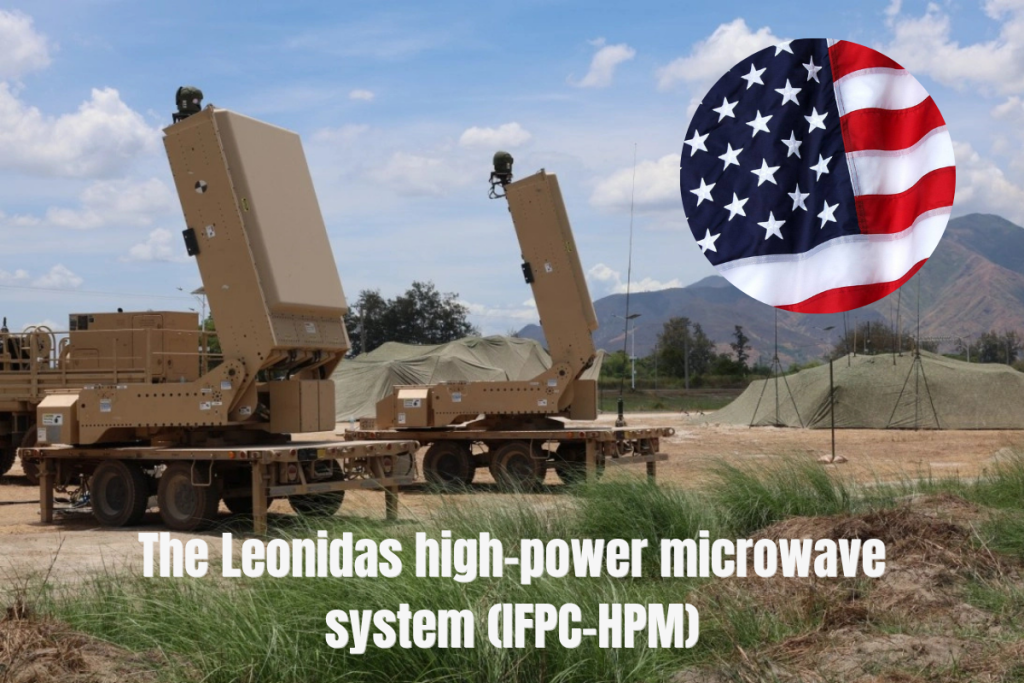
The microwave weapon is based on an architecture created by Epirus to effectively thwart large-scale drone strikes and safeguard vital infrastructure.
The manufacturer claims that the second-generation systems (Generation II) operate considerably better than their predecessors: power output has improved by about 30% and the effective fighting range has more than doubled to up to 2 km. The system can run without external power for up to 30 minutes because it has built-in batteries.
The U.S. Army received four IFPC-HPM I systems from Epirus in May 2024. They were put through a rigorous testing process that included combined exercises with operational units and air defense troops.
According to reports, the First Multi-Domain Task Force (MDTF) is using such technologies.
Leonidas (IFPC-HPM)
The U.S. Army’s layered defensive system includes IFPC-HPM (Integrated Fires Protection Capability – High-Powered Microwave), which guards against aerial attacks like drones, missiles, and artillery shells.
The IFPC-HPM uses concentrated microwave pulses to disrupt enemy weaponry’s electronics. It’s different from conventional air defense systems that destroy targets through physical impact.
The system’s development is a component of a larger U.S. Army modernization effort that aims to develop practical defenses against sophisticated aerial threats and drone swarms.
The IFPC-HPM can function as a member of a battle network and obtain real-time targeting info by integrating with other sensors and command-and-control components.
This weapon’s capacity to be reused again without refills is one of its main advantages, which makes it particularly appealing for extended combat operations or the defense of vital infrastructure.
However, the approach has several drawbacks, such as the need for a direct line of sight to the target and its reliance on weather.