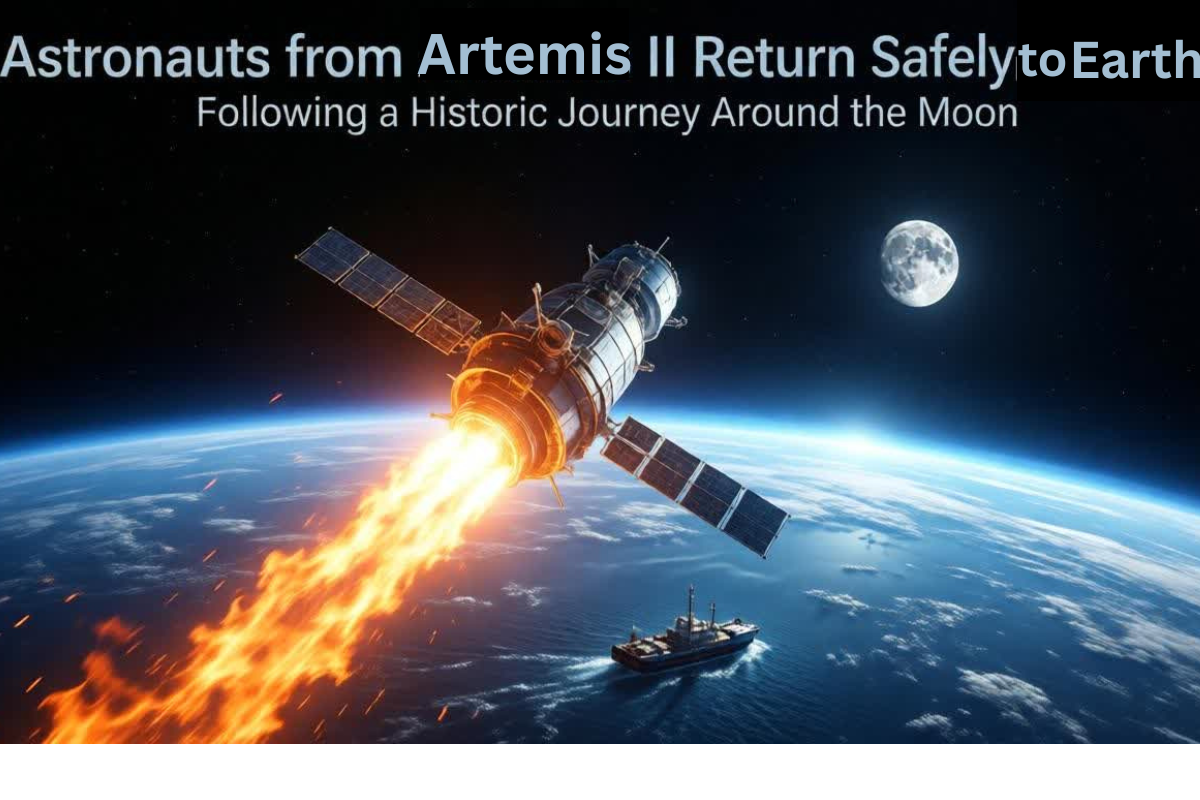
After nearly ten days in orbit, the Artemis II capsule and its four-person crew successfully splashed down in the Pacific Ocean on Friday, marking the first human journey to the moon’s vicinity in more than fifty years.
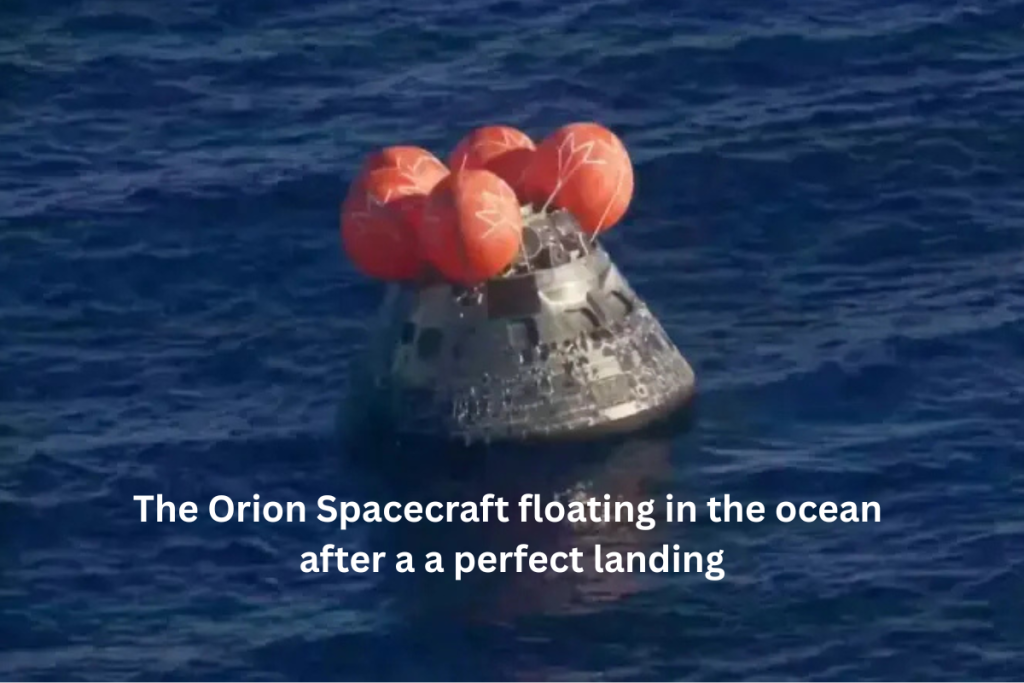
Just after 5:07 p.m., NASA’s gumdrop-shaped Orion capsule, named Integrity, softly parachuted into calm waters off the coast of Southern California. Pacific Time (0007 GMT on Saturday), bringing an end to a mission that, four days earlier, had taken the astronauts 252,756 miles beyond Earth—deeper into space than any previous flight.
The Artemis II voyage was the first crewed test flight in a series of Artemis missions that seek to return men to the lunar surface beginning in 2028. It covered a total of 694,392 miles (1,117,515 km) in two Earth orbits and a climactic lunar flyby about 4,000 miles from the surface.

A PERFECT LANDING
A NASA broadcast featured a live video feed of the splashdown under partially cloudy sky. Rob Navias, a NASA commentator, described the landing as “a perfect bull’s eye splashdown for Integrity and its four astronauts.” Shortly after splashdown, mission commander Reid Wiseman radioed, “We are stable one-four green crew members,” indicating that the capsule was upright and that all four astronauts were doing well.
The four crew members—Canadian astronaut Jeremy Hansen, 50, and American astronauts Wiseman, 50, Victor Glover, 49, and Christina Koch, 47—were retrieved from the floating capsule in less than two hours by NASA and the U.S. Navy recovery crews.
The mission’s most dangerous test was the crew’s return home, and their Lockheed Martin-built (LMT.N) new generation Orion spacecraft demonstrated that the capsule’s heat shield could withstand the intense forces of re-entry from a lunar-return trajectory.
At about 5,000 degrees Fahrenheit (2,760 degrees Celsius), atmospheric friction pummeled the capsule’s heat shield as it plummeted into Earth’s atmosphere at 32 times the speed of sound.

At the height of re-entry stress, a sheath of ionized gas surrounded the car, resulting in an expected radio blackout lasting more than six minutes.
Two sets of parachutes billowed from the nose of the free-falling spacecraft to slow its descent to roughly 15 mph (25 kph) before Orion gently impacted the ocean, breaking the tension as contact was restored some 40 seconds later than anticipated.
The four astronauts, clad in their orange space suits, were assisted into an inflatable raft after Navy divers affixed a floating collar to stabilize the capsule. They were then carried one by one to helicopters that were hovering over them and taken a short distance to the John P. Murtha, a nearby Navy amphibious transport ship, for additional medical checks.
Glover and Koch perched on the edge of a helicopter door on the flight deck, grinning widely and waving at the cameras. According to NASA, the crew was scheduled to spend the night on board the spacecraft before being taken to Houston on Saturday to meet up with their relatives.

On April 1, the quartet took off from Cape Canaveral, Florida, atop NASA’s massive Space Launch System rocket, completing two orbits of Earth before continuing on an unprecedented voyage around the moon.
By doing this, they became the first astronauts since the Apollo program of the 1960s and 1970s to orbit Earth’s lone natural satellite.
As the first Black astronaut, the first woman, and the first non-citizen to participate in a U.S. lunar mission, respectively, Glover, Koch, and Hansen also made history.
The crew’s maximum journey of 252,756 miles surpassed the Apollo 13 crew’s 1970 record of almost 248,000 miles.
Following the unmanned Artemis I – the Orion spacecraft’s test mission around the moon in 2022., this trip has served as a vital hardware test for a planned attempt later this decade to land astronauts on the moon’s surface for the first time since Apollo 17 in 1972.
China wants to send its own personnel to the moon by 2030, but NASA wants to accomplish a crewed moon landing before then. NASA’s more far-reaching goal is to develop a sustained lunar presence as a prelude to future human mission to Mars.
The Artemis II mission has unfolded against a backdrop of political and social unrest, including a U.S. military conflict that has proven unpopular at home, in a historical similarity to Apollo’s Cold War era.
In a time when big tech has gained widespread mistrust and even terror, the most recent moon shot, which enthralled a worldwide audience, reinforced the accomplishments of science and technology for many. According to the streaming service, almost 3 million people watched the splashdown on NASA’s YouTube page.
During its first test flight in 2022, the Orion spacecraft experienced an unanticipated degree of scorching and stress upon re-entry, putting its heat shield to the test. Consequently, NASA engineers modified Artemis II’s descent trajectory to minimize heat accumulation and lower the danger to the capsule and its crew.
In a message uploaded on his Truth Social platform, President Donald Trump commended the astronauts on their return, stating that “the entire trip was spectacular, the landing was perfect and, as President of the United States, I could not be more proud!”
The space agencies of Europe, Canada, and Japan have joined the U.S. lunar mission, along with commercial partners like Jeff Bezos’ Blue Origin and Elon Musk’s SpaceX, which are constructing the program’s lunar landers.
The voyage now completed, NASA’s attention immediately shifts to Artemis III, a mission scheduled for next year, which will involve a crewed docking test in Earth’s orbit with both lunar landers, before eventually attempting to land humans on the lunar surface for Artemis IV.